

Overview
Similar to other blockchains, Starknet uses the STRK token for paying fees to enable operation of the network, maintaining and securing the network by enabling staking for consensus, and deciding on Starknet’s values and technology goals by voting for governance proposals, of which ten billion tokens are planned to or have already been distributed, as well as, further tokens minted through an inflation mechanism. Major economic mechanisms of STRK, also known as tokenomics, are subject to change based on governance decisions made by the larger community of Starknet and are described here for informational purposes only.Background
Blockchains are valuable because they are data structures maintained by diverse and, ideally, large groups of otherwise unaffiliated persons. This gives them resilience: Any one participant can disappear, but the data structure is preserved. This also gives them censorship resistance: No single person can unilaterally decide to forbid certain persons from using the network. To achieve this, blockchains work through a combination of cryptography and economic incentives: Cryptography limits what actors in the system can do (for example, transactions must be validly signed to be included in the chain) and economic incentives encourage actors to voluntarily perform actions that maintain the network’s capabilities when spending their own resources (for example, miners or stakers actively publish new blocks to the chain because they can receive fees and new tokens as a reward). Starknet achieves secure low-cost transactions by using the STARK cryptographic proof system to reduce the size of transaction data while preserving and verifying the integrity of that data. To achieve resilience and censorship resistance, Starknet uses the STRK token to incentivize network participants to sequence transactions for users of the network and to ensure that there is a provably fair proof-of-stake mechanism to determine who should sequence and submit a proof for the network blocks.Purposes
- Transaction fees: Originally, fees in Starknet were paid only in Ether (ETH), which was followed by the functionality of paying fees for transactions on the network using both STRK, as well as ETH. As of the release of v.0.14.0 on September 1, 2025, transaction fees on Starknet can only be paid with STRK.
A portion of the fees paid in STRK may be converted to ETH by the receiving sequencer, in order to cover Ethereum L1 gas costs, which, due to the specifications of the Ethereum protocol, must be paid in ETH. - Staking: Certain services that are critical to the liveness and security of Starknet may require the staking of Starknet tokens. These services might be offered by multiple providers, and could include sequencing, reaching temporary L2 consensus before L1 finality is reached, STARK-proving services, and data availability provisioning, to name a few examples. Some of these protocol changes are still under discussion within the larger governance community and are targeted for 2025 -2026. As of the last update of this paper, staking is live and validators are required to attest blocks to ensure the network’s stability and security - for more information on Starknet staking, see here.
- Governance: Proposals for improving Starknet might require a minimal token support threshold. Voting, either directly or via delegation, will be required for changes to the protocol that are essential to Starknet’s liveness, security, and maintenance. Today, for example, major updates to the Starknet Operating System require the approval of token holders. For more information about Governance see the Starknet Governance Hub
Supply and distribution
Ten billion Starknet tokens were initially created by StarkWare in May 2022 and minted onchain on November 30, 2022. The existing ten billion tokens have been or are planned to be distributed according to the following: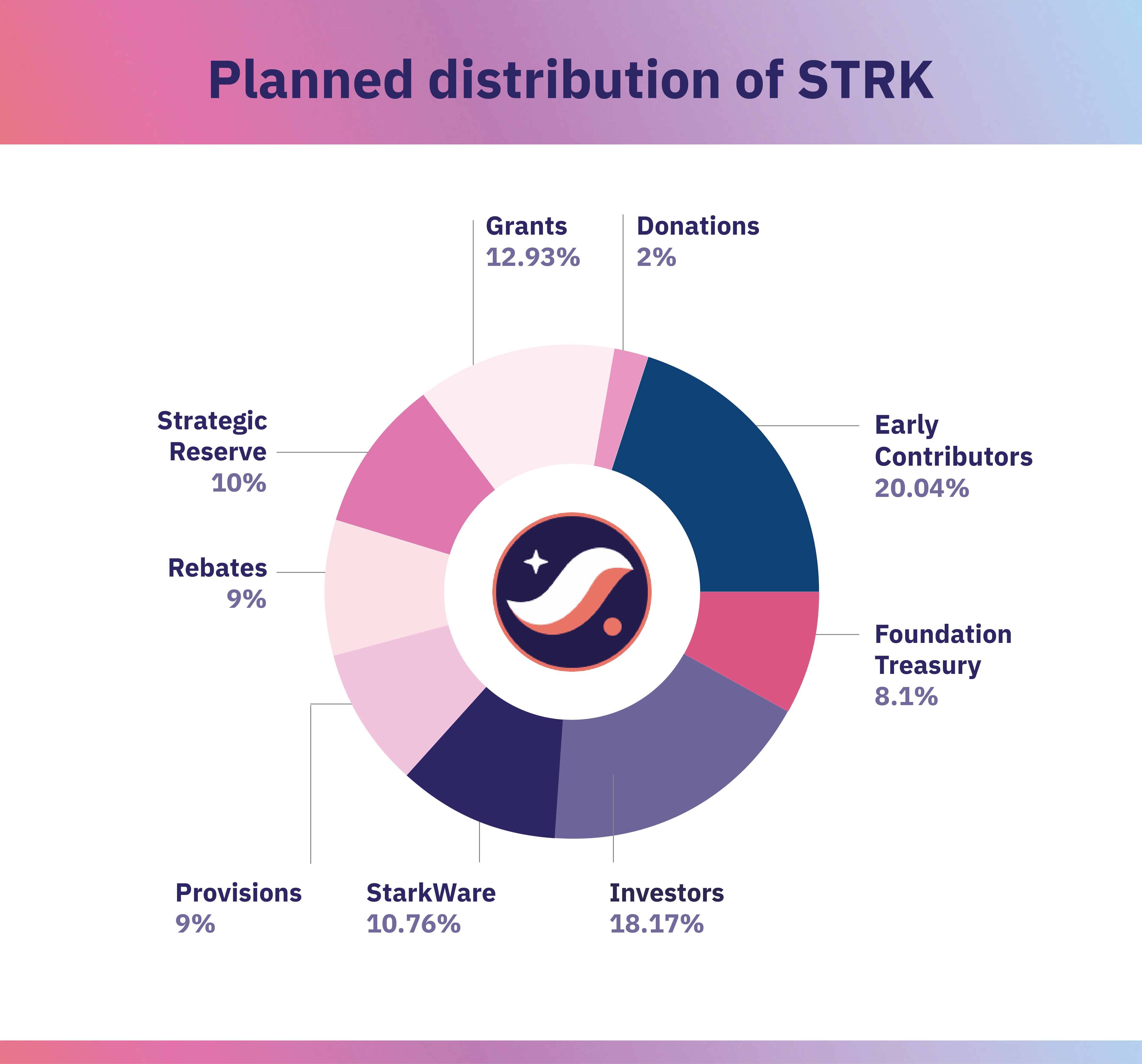
- Up to 0.64% (64 million tokens) have been unlocked on the 15th of each month, starting April 15, 2024, and going through March 15, 2025, for a total of 7.68% (768 million tokens) unlocked by March 15, 2025.
- Up to 1.27% (127 million tokens) have been and will be unlocked on the 15th of each month, starting April 15, 2025, and going through March 15, 2027, for a total of 30.48% (3.048 billion tokens) unlocked by March 15, 2027.
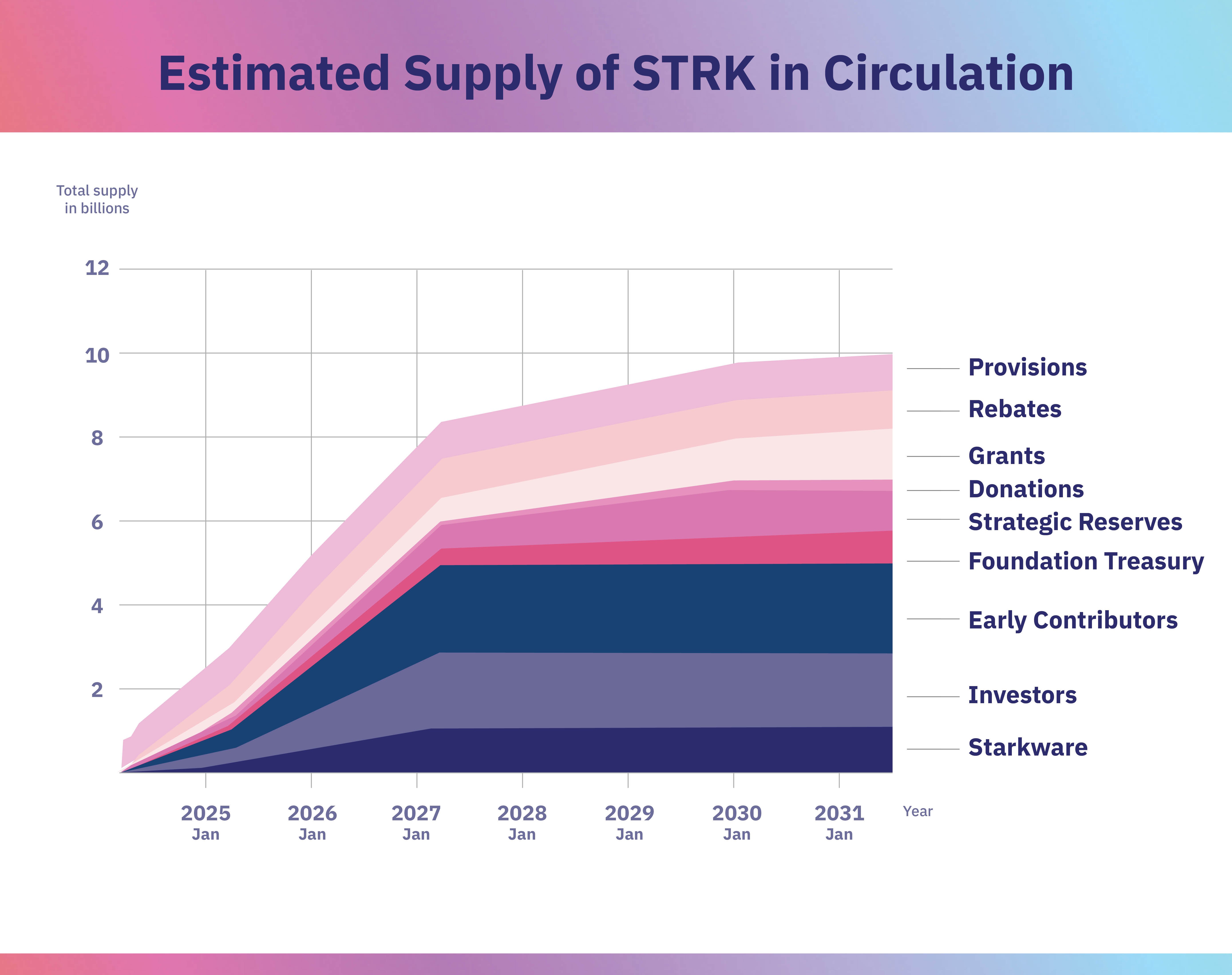
The above graph excludes newly circulating tokens resulting from inflation or staking (see below).Token allotments currently retained by the Starknet Foundation, while contractually unlocked, are not considered circulating unless granted, donated, or otherwise allocated out of originating wallets through future grants, provisions, donations, developer initiatives, or other programs.